What Is A Cup Size?
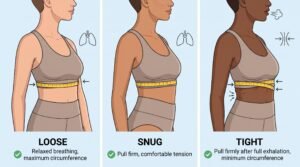
A cup size represents a 1-inch (2.54 cm) difference between your bust measurement and your underbust measurement. At a 34 band, an A cup holds approximately 130 cc of breast tissue volume. Use our bra size calculator to find your exact cup size based on six measurements: loose underbust, snug underbust, tight underbust, standing bust, leaning bust, and lying bust.
Cup size is the letter in a bra size (e.g., the A in 34A). It represents the difference between your bust measurement and your underbust measurement. Each letter equals approximately 1 inch (2.54 cm) of difference. An A cup sits at the smaller end of the standard cup range, one letter above AA and one letter below B.
The A cup is not a fixed volume. Because cup volume scales with band size, a 32A contains less breast tissue than a 38A, even though both carry the same letter. A 32A holds roughly 115 cc, while a 38A holds roughly 170 cc. This relationship between band size and cup volume is central to accurate bra size measurement, and it explains why the same cup letter can look noticeably different on two different body frames.
A Cup Measurements
A cup bra size measurements are determined by measuring two areas: the underbust (the circumference of your rib cage directly below your breasts) and the bust (the circumference around the fullest part of your breasts). The table below shows the exact bust measurement that corresponds to an A cup at each standard band size, in both inches and centimeters.
| Bra Size | Underbust (inches) | Underbust (cm) | Bust (inches) | Bust (cm) | ~Volume (cc) |
|---|---|---|---|---|---|
| 28A | 26-28 | 66-71 | 29 | 74 | ~100 |
| 30A | 28-30 | 71-76 | 31 | 79 | ~110 |
| 32A | 30-32 | 76-81 | 33 | 84 | ~115 |
| 34A | 32-34 | 81-86 | 35 | 89 | ~130 |
| 36A | 34-36 | 86-91 | 37 | 94 | ~150 |
| 38A | 36-38 | 91-97 | 39 | 99 | ~170 |
| 40A | 38-40 | 97-102 | 41 | 104 | ~190 |
To find your A cup bra size, measure your underbust in inches or centimeters, then measure your bust at the fullest point. If the difference between bust and underbust is approximately 1 inch (2.54 cm), your cup size is A. The band size (the number in your bra size) corresponds to your underbust measurement, rounded to the nearest even number. For a more precise result, our measurement guide explains the full six-measurement method used by professional fitters.
What Does A Cup Look Like?
An A cup bra size creates a subtle, proportional silhouette on the chest. The appearance varies significantly depending on band size, because a 30A sits on a smaller rib cage than a 36A, distributing 1 inch of cup projection across different frame widths.
On a smaller frame (bands 28 to 32), an A cup appears as a gentle, visible curve. On a larger frame (bands 36 to 40), the same A cup letter may appear flatter in proportion to the broader torso. This variation is why two people who both wear A cups can look quite different from one another.
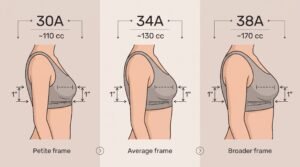
Several factors influence how an A cup appears beyond the band size: chest wall shape (flat, rounded, or protruding), breast root width (narrow versus wide), tissue distribution (full on top versus full on bottom), and body composition. An A cup on a person with a narrow root and projected tissue looks distinctly different from an A cup on a person with a wide root and shallow tissue, even at the same band size.
The measurement reality is simple: 1 inch of difference between bust and underbust, which translates to roughly 100 to 190 cc of volume depending on the band. For visual reference, 130 cc (at band 34) is comparable in volume to a small orange.
A Cup Sister Sizes
Sister sizes are bra sizes with the same cup volume but different band and cup combinations. Going up a band size means going down a cup letter, and vice versa. For an A cup, the sister sizes shift the fit between a tighter band with more cup projection and a looser band with less cup projection, while the total cup volume stays approximately equal.
| Your Size | Sister Size (Band Down, Cup Up) | Sister Size (Band Up, Cup Down) |
|---|---|---|
| 30A | 28B | 32AA |
| 32A | 30B | 34AA |
| 34A | 32B | 36AA |
| 36A | 34B | 38AA |
| 38A | 36B | 40AA |
When should you try a sister size? If an A cup band feels too tight but the cups fit correctly, try the next band up with a cup down (e.g., move from 32A to 34AA). If the band feels too loose but the cups are right, try the next band down with a cup up (e.g., move from 34A to 32B). The cup volume remains approximately the same at 130 cc (at the 34 reference band), but the fit distribution changes. Sister sizing is especially useful when a brand runs small or large in the band, or when your underbust measurement falls between two band sizes.
Best Bra Types for A Cup
Bra type selection for A cup sizes depends on the measurement-based fit characteristics of the cup: 1 inch of projection, relatively low volume, and a proportionally smaller cup area relative to the band. Certain bra types accommodate these measurements better than others from a structural and sizing perspective.
Bralettes and wire-free styles often provide the best measurement-to-fit ratio for A cups. With 1 inch of cup projection, the lighter construction of a bralette matches the lower support requirements, and sizing in S/M/L tends to be more forgiving for the A cup range.
Balconette bras work well because their wider-set straps and lower-cut cup shape accommodate the A cup’s proportions without excess fabric at the top of the cup. The horizontal cut line aligns with smaller projection measurements.
T-shirt bras with light padding provide a smooth line under clothing. For A cups, look for bras labeled “demi” or “half-cup” in your band size, as full-cup styles designed for larger cups may gap at the top when the projection measures only 1 inch.
Push-up bras add approximately 1 to 2 inches of visual projection through padding placement. From a sizing perspective, the band measurement remains the same, but the added padding effectively creates the visual profile of a B or C cup.
Bra types that tend to fit poorly at A cup sizes include full-coverage bras (excess fabric at the top due to insufficient projection), minimizer bras (designed to reduce projection in larger cups), and longline bras with tall cup panels (insufficient tissue to fill the extended cup area).
A Cup vs AA Cup and A Cup vs B Cup
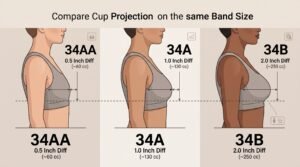
The Measurement difference between adjacent cup sizes is approximately 1 inch (2.54 cm) per letter. Understanding where A cup sits between AA and B clarifies what the A designation means in precise terms.
A Cup vs AA Cup: An AA cup represents a 0.5-inch difference between bust and underbust, while an A cup represents a 1-inch difference. At a 34 band, this translates to approximately 60 cc (AA) versus 130 cc (A) of cup volume. The bust measurement for a 34AA is 34.5 inches (87.6 cm), compared to 35 inches (89 cm) for a 34A.
A Cup vs B Cup: A B cup represents a 2-inch difference between bust and underbust, compared to the A cup’s 1-inch difference. At a 34 band, this translates to approximately 130 cc (A) versus 250 cc (B) of cup volume. The bust measurement for a 34A is 35 inches (89 cm), compared to 36 inches (91 cm) for a 34B. Visually, a B cup has noticeably more projection and fullness than an A cup at the same band size.
If your bust measurement falls between the A and B cup thresholds (for example, a 1.5-inch difference at a 34 band), the six-measurement method that includes standing bust, leaning bust, and lying bust can determine which cup provides the better fit. The bra size calculator accounts for this variation automatically.
Is A Cup Small?
A cup is below the US average bra size of 34DD. In volume terms, an A cup at band 34 holds approximately 130 cc, compared to approximately 500 cc for the average 34DD. By this measurement comparison, A cup is a smaller cup size.
However, “small” is relative to the band size and frame. A 36A has more absolute cup volume (approximately 150 cc) than a 28A (approximately 100 cc). And a 28A on a narrow frame may appear proportionally similar to a 34A on a medium frame, because the bust-to-frame ratio matters as much as the raw measurement difference.
An estimated 5 to 8% of bra wearers in the US wear A cup sizes. The percentage is higher among younger demographics and varies across geographic regions. It is worth noting that approximately 80% of women wear the wrong bra size, according to fitting studies conducted by professional bra fitting services. Many people currently wearing A cups may actually measure as AA or B cups when using the full six-measurement method.
From a bra size measurement perspective, what matters is not whether A cup is “small” or “large” in abstract terms, but whether it matches your actual bust-to-underbust difference of 1 inch (2.54 cm). The correct size is the measured size.
A Cup in International Sizes
The A cup letter is used across US, UK, European, Australian, and Japanese bra sizing systems, but the band numbering differs between systems. The cup letter “A” represents approximately the same bust-to-underbust difference internationally, with minor variations in rounding methods between sizing standards.
| US Size | UK Size | EU Size | AU Size | JP Size |
|---|---|---|---|---|
| 30A | 30A | 65A | 8A | A65 |
| 32A | 32A | 70A | 10A | A70 |
| 34A | 34A | 75A | 12A | A75 |
| 36A | 36A | 80A | 14A | A80 |
| 38A | 38A | 85A | 16A | A85 |
EU sizes use centimeter-based band numbers (65, 70, 75, 80, 85), where the number represents the underbust measurement in centimeters. Australian sizes use even numbers starting from 8, increasing by 2 for each band increment. Japanese sizes reverse the order, placing the cup letter before the band number (A75 instead of 75A). The US and UK A cup are identical in both band numbering and cup difference calculation, though some UK brands may use slightly different underbust-to-band rounding.
For precise size conversion when shopping internationally, enter your measurements in our bra size calculator and select the sizing system you need. The calculator converts between US, UK, EU, Australian, and Japanese sizes based on your measurements rather than simple letter-to-letter matching.