A bra size chart maps your underbust and bust measurements to a specific band and cup combination. The chart below covers all standard US sizes from 28AA through 52N, with measurements provided in both inches and centimeters. To find your size, measure your underbust (rib cage below the breasts) and bust (fullest point), then locate the intersection on the chart. For the most accurate result, use our bra size calculator, which uses six measurements instead of two.
Complete Bra Size Chart
The complete bra size chart below shows every standard band and cup combination with the corresponding bust measurement in inches. Band size represents your underbust measurement rounded to the nearest even number. Cup size represents the difference between your bust measurement and your underbust measurement, where each cup letter equals approximately 1 inch (2.54 cm) of difference.
| Band Size | Underbust (in) | Underbust (cm) | A Cup Bust | B Cup Bust | C Cup Bust | D Cup Bust | DD Cup Bust | DDD/F Cup Bust | G Cup Bust | H Cup Bust |
|---|---|---|---|---|---|---|---|---|---|---|
| 28 | 26-28 | 66-71 | 29 | 30 | 31 | 32 | 33 | 34 | 35 | 36 |
| 30 | 28-30 | 71-76 | 31 | 32 | 33 | 34 | 35 | 36 | 37 | 38 |
| 32 | 30-32 | 76-81 | 33 | 34 | 35 | 36 | 37 | 38 | 39 | 40 |
| 34 | 32-34 | 81-86 | 35 | 36 | 37 | 38 | 39 | 40 | 41 | 42 |
| 36 | 34-36 | 86-91 | 37 | 38 | 39 | 40 | 41 | 42 | 43 | 44 |
| 38 | 36-38 | 91-97 | 39 | 40 | 41 | 42 | 43 | 44 | 45 | 46 |
| 40 | 38-40 | 97-102 | 41 | 42 | 43 | 44 | 45 | 46 | 47 | 48 |
| 42 | 40-42 | 102-107 | 43 | 44 | 45 | 46 | 47 | 48 | 49 | 50 |
| 44 | 42-44 | 107-112 | 45 | 46 | 47 | 48 | 49 | 50 | 51 | 52 |
| 46 | 44-46 | 112-117 | 47 | 48 | 49 | 50 | 51 | 52 | 53 | 54 |
| 48 | 46-48 | 117-122 | 49 | 50 | 51 | 52 | 53 | 54 | 55 | 56 |
| 50 | 48-50 | 122-127 | 51 | 52 | 53 | 54 | 55 | 56 | 57 | 58 |
| 52 | 50-52 | 127-132 | 53 | 54 | 55 | 56 | 57 | 58 | 59 | 60 |
All bust measurements in the chart above are shown in inches. To convert any value to centimeters, multiply by 2.54. For example, a bust measurement of 36 inches equals 91.4 cm. The chart uses the US sizing standard, where cup size is determined by the difference between your bust and underbust measurements. Each cup letter corresponds to approximately 1 inch (2.54 cm) of difference: A = 1 inch, B = 2 inches, C = 3 inches, D = 4 inches, DD = 5 inches, DDD/F = 6 inches, G = 7 inches, and H = 8 inches.
How to Read This Bra Size Chart
Reading a bra size chart requires two measurements: your underbust and your bust. The number in a bra size (the 34 in 34C, for example) is the band size. It corresponds to your underbust measurement in inches, rounded to the nearest even number. The letter (the C in 34C) is the cup size. It represents the difference between your bust measurement and your underbust measurement, where each letter equals approximately 1 inch (2.54 cm) of difference.
Understanding Band Size
Band size is the foundation of every bra size. It is determined by the circumference of your rib cage measured directly below your breasts, in inches or centimeters. To find your band size on the chart, locate your underbust measurement in the second column. If your underbust measures 33 inches (83.8 cm), your band size is 34, because band sizes round to the nearest even number. A snug underbust measurement ensures the band sits firmly without riding up the back, which is the most common sign of an incorrect band size.
For the most precise band size determination, our six-measurement method uses three underbust measurements: loose, snug, and tight. This accounts for different rib cage shapes and bra band stretch levels. You can learn the full process in our guide on how to measure bra size at home.
Understanding Cup Size
Cup size is not a fixed volume. It is relative to the band size it is paired with. A D cup on a 32 band holds significantly less volume than a D cup on a 40 band. The letter represents the inch difference between bust and underbust: A = 1 inch, B = 2 inches, C = 3 inches, D = 4 inches, DD/E = 5 inches, DDD/F = 6 inches. At a 34 band, an A cup holds approximately 130cc of volume, a B cup holds approximately 250cc, a C cup holds approximately 310cc, and a D cup holds approximately 400cc.
To find your cup size on the chart, subtract your underbust measurement from your bust measurement. If your bust is 37 inches and your underbust is 34 inches, the difference is 3 inches, which corresponds to a C cup. Your bra size would be 34C. For a more precise calculation, especially if you fall between sizes, the bra size calculator uses standing, leaning, and lying bust measurements to account for differences in breast tissue distribution.
Cup Size Chart by Measurement
The cup size chart below converts the difference between your bust measurement and underbust measurement into a cup letter. This difference-based system is the standard used in US bra sizing, and it applies across all band sizes from 28 through 52.
| Bust Minus Underbust (inches) | Bust Minus Underbust (cm) | US Cup Size | UK Cup Size | Approximate Volume at Band 34 (cc) |
|---|---|---|---|---|
| 0.5 | 1.3 | AA | AA | ~60 |
| 1 | 2.5 | A | A | ~130 |
| 2 | 5.1 | B | B | ~250 |
| 3 | 7.6 | C | C | ~310 |
| 4 | 10.2 | D | D | ~400 |
| 5 | 12.7 | DD | DD | ~500 |
| 6 | 15.2 | DDD/F | E | ~600 |
| 7 | 17.8 | G | F | ~700 |
| 8 | 20.3 | H | FF | ~850 |
| 9 | 22.9 | I | G | ~1000 |
| 10 | 25.4 | J | GG | ~1150 |
| 11 | 27.9 | K | H | ~1300 |
Notice that US and UK cup sizes diverge starting at DD. In the US system, sizes progress as DD, DDD (or F), G, H, I, J, K. In the UK system, sizes progress as DD, E, F, FF, G, GG, H. This means a US DDD is equivalent to a UK E, and a US G is equivalent to a UK F. The volume column provides approximate breast tissue volume at band 34 for reference; actual volume shifts up or down as band size changes. A 32D holds less volume than a 36D, even though both are labeled “D cup.”
Understanding how cup volume relates to measurements is essential for accurate bra sizing. Sister sizes share the same cup volume across different band and cup combinations. For example, 34C, 32D, and 36B all hold approximately 310cc, despite their different labels. This concept becomes especially important when a specific band size feels too tight or too loose. You can explore sister size relationships through our bra sister sizes guide.
Bra Size Chart by Country
Bra sizes vary significantly by country because each region uses a different measurement standard. The international conversion chart below shows equivalent sizes across five major sizing systems: US, UK, European (EU), Australian (AU), and Japanese (JP). US and UK systems use inches. EU sizing uses centimeters for band sizes (60, 65, 70, 75, 80, and so on), and cup letters differ after D.
| US Size | UK Size | EU Size | AU Size | JP Size |
|---|---|---|---|---|
| 30A | 30A | 65A | 8A | 65A |
| 30B | 30B | 65B | 8B | 65B |
| 32A | 32A | 70A | 10A | 70A |
| 32B | 32B | 70B | 10B | 70B |
| 32C | 32C | 70C | 10C | 70C |
| 32D | 32D | 70D | 10D | 70D |
| 34B | 34B | 75B | 12B | 75B |
| 34C | 34C | 75C | 12C | 75C |
| 34D | 34D | 75D | 12D | 75D |
| 34DD | 34DD | 75E | 12DD | 75E |
| 36B | 36B | 80B | 14B | 80B |
| 36C | 36C | 80C | 14C | 80C |
| 36D | 36D | 80D | 14D | 80D |
| 36DD | 36DD | 80E | 14DD | 80E |
| 36DDD | 36E | 80F | 14E | 80F |
| 38C | 38C | 85C | 16C | 85C |
| 38D | 38D | 85D | 16D | 85D |
| 38DD | 38DD | 85E | 16DD | 85E |
| 40C | 40C | 90C | 18C | 90C |
| 40D | 40D | 90D | 18D | 90D |
EU band sizes convert from inches to centimeters using a specific formula: a US 32 band equals EU 70, US 34 equals EU 75, US 36 equals EU 80, and so on, increasing by 5 for each 2-inch band increment. Australian sizes use a numbered system starting lower: a US 32 equals AU 10, US 34 equals AU 12, US 36 equals AU 14. Japanese sizing closely mirrors EU sizing for band numbers but may differ slightly in cup progression.
Cup letter conversions require extra attention because the naming conventions diverge past D cup. A US DDD is equivalent to a UK E. A US G is equivalent to a UK F. Ordering from international brands without converting correctly is one of the most common causes of poor fit. For a complete conversion table covering all sizes and systems, see our bra size conversion chart.
Band Size Chart
Band sizes range from 26 to 52 in standard US sizing, covering rib cage circumferences from 24 inches (61 cm) to 52 inches (132 cm). The band provides approximately 80% of a bra’s support, making accurate band sizing the single most important measurement in bra fitting. Below is the complete band size reference with underbust measurements in both inches and centimeters.
| Band Size | Snug Underbust (inches) | Snug Underbust (cm) | Loose Underbust (inches) | EU Equivalent | AU Equivalent |
|---|---|---|---|---|---|
| 26 | 24-26 | 61-66 | 25-27 | 55 | 4 |
| 28 | 26-28 | 66-71 | 27-29 | 60 | 6 |
| 30 | 28-30 | 71-76 | 29-31 | 65 | 8 |
| 32 | 30-32 | 76-81 | 31-33 | 70 | 10 |
| 34 | 32-34 | 81-86 | 33-35 | 75 | 12 |
| 36 | 34-36 | 86-91 | 35-37 | 80 | 14 |
| 38 | 36-38 | 91-97 | 37-39 | 85 | 16 |
| 40 | 38-40 | 97-102 | 39-41 | 90 | 18 |
| 42 | 40-42 | 102-107 | 41-43 | 95 | 20 |
| 44 | 42-44 | 107-112 | 43-45 | 100 | 22 |
| 46 | 44-46 | 112-117 | 45-47 | 105 | 24 |
| 48 | 46-48 | 117-122 | 47-49 | 110 | 26 |
| 50 | 48-50 | 122-127 | 49-51 | 115 | 28 |
| 52 | 50-52 | 127-132 | 51-53 | 120 | 30 |
The most common band sizes sold in the US are 32 through 38, which fit rib cage circumferences of approximately 30 to 38 inches (76 to 97 cm). Band sizes below 30 and above 42 are considered extended sizes and may require shopping from specialty brands. If your underbust falls between two band sizes, your tight underbust measurement helps determine which direction to round: a tighter underbust suggests the smaller band for more support, while a larger difference between loose and tight underbust measurements suggests the larger band for comfort.
Each band size connects to a full range of cup options. A 32 band is available in cups from AA through K or beyond, depending on the manufacturer. Similarly, a 36 band pairs with the same cup range. The band number determines the frame, while the cup letter determines the volume, and together they define the complete bra size. For detailed information about specific band sizes and their available cup combinations, see our individual band size guides.
Bra Size Chart with Visual References
Cup sizes look different depending on the band size they are paired with, body proportions, and breast shape. A C cup on a 32 band appears visually larger relative to the frame than a C cup on a 40 band, even though the 40C actually holds more volume. This is why visual references are only meaningful when the band size is specified alongside the cup letter.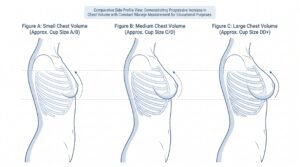
Below is an approximate visual reference for how each cup size relates to measurements and volume at a 34 band, which is close to the US average band size.
| Cup Size | Inch Difference | CM Difference | Volume at 34 Band (cc) | General Description |
|---|---|---|---|---|
| AA | 0.5 | 1.3 | ~60 | Minimal projection from the chest wall |
| A | 1 | 2.5 | ~130 | Slight, gentle curve from the chest |
| B | 2 | 5.1 | ~250 | Noticeable but moderate projection |
| C | 3 | 7.6 | ~310 | Moderate, well-defined shape |
| D | 4 | 10.2 | ~400 | Full, clearly defined shape |
| DD/E | 5 | 12.7 | ~500 | Full with significant projection |
| DDD/F | 6 | 15.2 | ~600 | Large, extends well past the chest wall |
| G | 7 | 17.8 | ~700 | Very full, requires structured support |
| H | 8 | 20.3 | ~850 | Very large, strong support essential |
| I | 9 | 22.9 | ~1000 | Extra large, specialty sizing recommended |
These descriptions are approximations. Breast shape (round, projected, shallow, east-west, bell, teardrop) significantly affects how a given size appears on the body, even when measurements are identical. Two people wearing 34D may look very different depending on tissue distribution and root width. The measurements, not the visual appearance, determine the correct size. For a detailed guide to how breast shape affects bra fit, see our breast shapes guide.
The average bra size in the US is 34DD, according to the most recent industry surveys. This means approximately half of bra wearers fall above DD and half fall below. Common misconceptions persist about D and DD cup sizes being “large,” but in measurement terms, a D cup represents only a 4-inch (10.2 cm) difference between bust and underbust, and DD represents a 5-inch (12.7 cm) difference. For individual cup size breakdowns, see our guides for A cup, B cup, C cup, D cup, DD cup, and DDD cup sizes.
How to Use This Chart to Find Your Bra Size
Finding your bra size from this chart takes three steps, starting with two measurements that you can take at home with a soft measuring tape. The entire process requires less than five minutes. For the highest accuracy, measure without a bra or in a non-padded, unlined bra.
Step 1: Measure Your Underbust
Wrap a soft measuring tape around your rib cage directly below your breasts. Keep the tape level all the way around and parallel to the floor. Take three measurements if possible: one with the tape resting loosely on the skin (loose underbust), one with comfortable tension (snug underbust), and one pulled as tight as you can while still breathing (tight underbust). The snug measurement is your primary reference for finding your band size on the chart.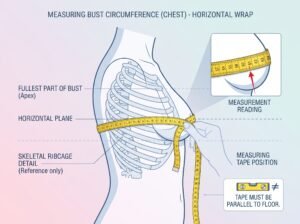
Step 2: Measure Your Bust
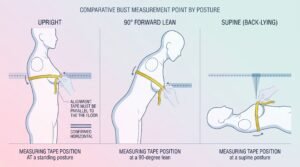
Wrap the tape around the fullest part of your bust with your arms relaxed at your sides. Keep the tape level and avoid pulling it tight. For best results, take three bust measurements: standing upright, leaning forward at a 90-degree angle (which captures full breast projection), and lying on your back. The average of these three measurements gives the most accurate cup determination, especially for breasts with significant projection or soft tissue.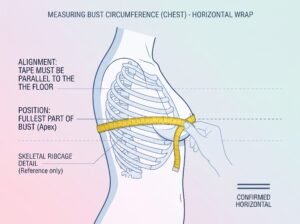
Step 3: Find Your Size on the Chart
Locate your underbust measurement in the band size chart to determine your band number. Then subtract your underbust from your bust measurement to find the inch difference. Look up that difference in the cup size chart to determine your cup letter. Combine the two: if your underbust is 34 inches and your bust is 38 inches, the difference is 4 inches, which equals a D cup, making your size 34D.
If your measurement falls exactly between two cup sizes, round up for a more comfortable fit. If your underbust falls between two band sizes and you prefer a snugger fit, choose the smaller band with the next cup size up (a sister size). For example, if you measure between 34C and 36B, both sizes hold the same cup volume. The 34C provides a firmer band, while the 36B offers a looser band with the same cup capacity.
The most reliable method is to use our bra size calculator, which processes all six measurements (loose underbust, snug underbust, tight underbust, standing bust, leaning bust, lying bust) through an algorithm that accounts for breast shape, tissue distribution, and band stretch. The calculator also provides sister size alternatives and international equivalents for your result.
Common Bra Sizing Mistakes and How to Avoid Them
Approximately 80% of women wear the wrong bra size, according to multiple professional fitting studies. Most sizing errors stem from measurement mistakes or misunderstanding how bra sizes work. The chart above is only as accurate as the measurements you put into it.
Measuring Over a Padded Bra
Padded bras add 0.5 to 2 inches (1.3 to 5.1 cm) to your bust measurement, which inflates the cup size result by one to two cup letters. Always measure without a bra or in a thin, non-padded bra. If you must wear a bra during measurement, choose one with no padding, no lining, and no push-up features.
Using the Outdated Plus-4 Method
Some retailers still instruct customers to add 4 inches to their underbust measurement before determining band size. This outdated method, developed decades ago when bra bands had minimal stretch, systematically puts people in bands that are too large and cups that are too small. Modern bra bands have significant elastic stretch, so your actual underbust measurement (rounded to the nearest even number) is your band size. The chart on this page uses the modern, direct measurement method.
Ignoring Sister Sizes
When a bra size feels close but not quite right, the solution is often a sister size rather than a completely different size. Sister sizes are bra sizes with the same cup volume but different band and cup combinations. Going up a band size means going down a cup letter, and vice versa. For example, 34C, 32D, and 36B are sister sizes that all share the same cup volume of approximately 310cc.
Assuming Cup Size Is Fixed Across Brands
A 34C in one brand may fit differently than a 34C in another because manufacturers use slightly different size specifications and patterns. Always verify your size when trying a new brand. Our brand-specific sizing guides for Victoria’s Secret, Calvin Klein, and other major brands explain exactly how each brand’s sizing compares to standard measurements.
When to Re-measure Your Bra Size ?
Bra size is not permanent. Body changes can shift both band and cup size over time. You should measure yourself at least every 6 months to ensure your current bra size still matches your measurements. Specific events that warrant immediate re-measurement include weight changes of 5 pounds (2.3 kg) or more, pregnancy, postpartum or post-nursing transitions, hormonal shifts related to menstruation or menopause, and changes in fitness level or body composition.
If you notice any signs of poor fit, such as the band riding up in the back, cups gaping at the top, straps digging into the shoulders, or spillage over the cup edges, these indicate that your current size no longer matches your measurements. Our bra fit guide explains the five-point fit check you can perform at home to assess whether your bra fits correctly. For a quick and thorough re-check, return to our bra size calculator to recalculate your size with fresh measurements.
Frequently Asked Questions
What is the most common bra size?
34DD is the most common bra size in the United States, based on the most recent industry fitting data. This has increased from 34B, which was the reported average in the early 2000s. The shift reflects both changes in body composition and improved awareness of correct bra fitting methods that identify larger cup sizes more accurately.
Is DD the same as E?
DD and E refer to the same cup size in most contexts. In the US system, the progression goes D, DD, DDD. In the UK system, it goes D, DD, E. Both DD (US) and E (UK) represent a 5-inch (12.7 cm) difference between bust and underbust. When shopping across US and UK brands, be aware that a US DDD equals a UK E, and a US G equals a UK F, because the naming systems diverge after DD.
Does cup size change with band size?
Yes. Cup size is relative to band size, not absolute. A D cup on a 32 band has less physical volume than a D cup on a 38 band, even though both are labeled “D.” This is because the cup letter represents the inch difference between bust and underbust, and the band circumference determines the overall frame. A 32D and a 38D are not the same volume. This is one of the most common misconceptions in bra sizing.
How accurate are bra size charts compared to calculators?
A standard two-measurement bra size chart provides a solid starting point, but it cannot account for variables like breast shape, tissue distribution, or asymmetry. Our bra size calculator uses six measurements (3 underbust: loose, snug, tight, plus 3 bust: standing, leaning, lying) to produce a result that accounts for these factors. The six-measurement method is more accurate for approximately 70% of people compared to the two-measurement chart method, particularly for those with very projected or very shallow breast tissue.
What if I fall between two sizes on the chart?
If your measurements place you between two sizes, try both along with their sister sizes. For example, if you fall between 34C and 34D, also try 32D (sister to 34C with a tighter band) and 36C (sister to 34D with a looser band). The ideal fit has a band that is firm but allows two fingers underneath, cups that fully contain breast tissue without gaping, and straps that stay in place without digging in. Use our bra size calculator for a more precise recommendation.
Can I use this chart for sports bras?
This chart covers standard bra sizing. Sports bras may use either band-and-cup sizing (identical to this chart) or alpha sizing (XS, S, M, L, XL). For sports bras that use alpha sizing, you will need a separate conversion. Our sports bra size guide provides the conversion tables from standard sizes to sports bra sizes across major athletic brands.
How do I convert my US size to UK or European?
Use the international conversion chart in the section above, or see our complete bra size conversion chart for all sizes and systems. The key differences are: EU uses centimeter-based band numbers (US 32 = EU 70, US 34 = EU 75), AU uses a separate numbering system (US 32 = AU 10, US 34 = AU 12), and UK cup letters diverge from US after DD.