What Is the Underbust Measurement?
The underbust measurement is the circumference of your rib cage measured directly below your breasts, in inches or centimeters. This single measurement determines the band size number in every bra size, making it the foundation of accurate bra sizing. A 34 band, for example, corresponds to an underbust measurement of approximately 33 to 34 inches (84 to 86 cm). Without an accurate underbust measurement, the entire bra size calculation starts from a flawed baseline.
Your underbust and your band size are directly linked. The band size is the number in a bra size (e.g., the 34 in 34C). It corresponds to your underbust measurement in inches, rounded to the nearest even number. Because the band provides approximately 80% of a bra’s support, getting this measurement right matters more than any other step in the sizing process. A band that is too loose rides up in the back and shifts throughout the day. A band that is too tight digs into your skin and creates discomfort around your rib cage.
Our bra size calculator uses three separate underbust measurements rather than one to account for differences in rib cage compressibility, breathing patterns, and tissue distribution. This three-measurement approach produces a more precise band size recommendation than the traditional single-measurement method that most retailers still use. Understanding what the underbust measurement is, and how to take it correctly, is the first step toward finding your actual bra size.
The 3 Underbust Measurements Explained
Three underbust measurements taken at different tension levels capture the full range of your rib cage circumference, from relaxed breathing to full exhalation. Each measurement serves a specific purpose in calculating your band size, and together they produce a recommendation that accounts for body variation no single measurement can address.
Loose Underbust Measurement
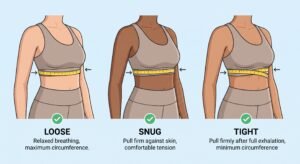
The loose underbust is taken with the tape measure resting flat against your skin without any tension or compression. Stand upright with your arms at your sides, breathe normally, and let the tape sit at the level directly below your breasts. The tape should be level all the way around, parallel to the floor, and should not press into your skin at all. This measurement represents the maximum circumference of your rib cage during relaxed breathing.
A typical loose underbust measurement runs 1 to 2 inches (2.5 to 5 cm) larger than the snug underbust. If you measure 33 inches (84 cm) as your loose underbust, your snug measurement will likely fall near 31 to 32 inches (79 to 81 cm). The loose measurement helps identify your starting band range and indicates how much flesh and tissue sits around your rib cage. People with more soft tissue around the underbust area tend to show a larger gap between their loose and tight measurements.
Snug Underbust Measurement
The snug underbust is the most commonly used single measurement in traditional bra fitting. Wrap the tape measure around your rib cage directly below your breasts and pull it firm against your skin, comfortably tight, similar to how a well-fitting bra band should feel when worn on the loosest hook. The tape should not slide easily but should not dig into your skin or restrict your breathing.
For many people, the snug underbust measurement falls closest to the actual band size number. A snug underbust of 32 inches (81 cm) typically corresponds to a 32 band. However, this varies depending on the difference between your three measurements. Someone with a snug underbust of 32 inches but a tight underbust of 29 inches (74 cm) may find that a 30 band provides better support, because the large gap between snug and tight indicates significant rib cage compressibility. This is why using all three measurements produces a more reliable result than the snug measurement alone.
Tight Underbust Measurement
The tight underbust measurement is taken with the tape measure pulled as tight as physically comfortable while exhaling fully. This measurement captures the minimum circumference of your rib cage when compressed to its smallest point. Stand upright, exhale completely, and pull the tape measure firmly around your underbust. The tape should press into your skin noticeably, though it should not cause pain.
The tight measurement serves as the lower boundary of your band size range. It helps prevent recommending a band size that would stretch to a circumference larger than your rib cage, which would cause the band to ride up and lose its ability to provide support. A tight underbust of 29 inches (74 cm) tells the calculator that a 30 band will still grip your rib cage securely when stretched, while a 28 band might feel uncomfortably restrictive. The difference between your loose and tight underbust measurements typically ranges from 2 to 4 inches (5 to 10 cm), though this varies significantly based on body composition and rib cage flexibility.
Why 3 Measurements Instead of 1?
Three underbust measurements produce a more accurate band size recommendation because different bra bands have different stretch characteristics. A single measurement cannot account for how your rib cage interacts with different levels of band elasticity. The three-measurement method, used by our bra size calculator and adapted from the methodology popularized by fitting communities, addresses this limitation directly.
Bra bands are designed to stretch. A new bra should be worn on the loosest hook, providing room to tighten as the elastic relaxes over time. The amount a band stretches depends on the materials, construction, and brand. Some bra bands stretch 2 inches (5 cm) beyond their resting length, while others stretch 4 inches (10 cm) or more. Your three underbust measurements create a range that the calculator matches against these stretch characteristics to find the band size that will fit snugly without being too tight or too loose.
Consider two people who both measure 32 inches (81 cm) at the snug underbust level. Person A has a loose underbust of 34 inches (86 cm) and a tight underbust of 30 inches (76 cm), a 4-inch (10 cm) range. Person B has a loose underbust of 33 inches (84 cm) and a tight underbust of 31.5 inches (80 cm), a 1.5-inch (4 cm) range. Despite sharing the same snug measurement, Person A has significantly more rib cage compressibility and may prefer a snugger 30 band for better support, while Person B would likely find a 32 band ideal. A single snug measurement would recommend the same band for both, ignoring the meaningful difference in how each rib cage responds to compression.
The tight underbust measurement also prevents a common sizing error: recommending a band that is too large. Approximately 80% of women wear the wrong bra size, according to multiple professional fitting studies. The most frequent mistake is wearing a band that is too loose, which shifts support burden onto the straps and causes the bra to ride up in the back. By measuring how tightly the rib cage can be compressed, the three-measurement method ensures the recommended band provides firm support without exceeding comfort limits.
Underbust to Band Size Conversion
Your underbust measurement converts to a band size number through a straightforward process. The band size is your snug underbust measurement in inches, rounded to the nearest even number. A snug underbust of 33 inches (84 cm) rounds to a 34 band, while a snug underbust of 31 inches (79 cm) rounds to a 32 band. The table below shows the full conversion from underbust measurements to standard US band sizes.
| Snug Underbust (inches) | Snug Underbust (cm) | US Band Size | EU Band Size | UK Band Size |
|---|---|---|---|---|
| 24.5 to 25.5 | 62 to 65 | 26 | 55 | 26 |
| 25.5 to 27.5 | 65 to 70 | 28 | 60 | 28 |
| 27.5 to 29.5 | 70 to 75 | 30 | 65 | 30 |
| 29.5 to 31.5 | 75 to 80 | 32 | 70 | 32 |
| 31.5 to 33.5 | 80 to 85 | 34 | 75 | 34 |
| 33.5 to 35.5 | 85 to 90 | 36 | 80 | 36 |
| 35.5 to 37.5 | 90 to 95 | 38 | 85 | 38 |
| 37.5 to 39.5 | 95 to 100 | 40 | 90 | 40 |
| 39.5 to 41.5 | 100 to 105 | 42 | 95 | 42 |
| 41.5 to 43.5 | 105 to 110 | 44 | 100 | 44 |
| 43.5 to 45.5 | 110 to 115 | 46 | 105 | 46 |
| 45.5 to 47.5 | 115 to 120 | 48 | 110 | 48 |
| 47.5 to 49.5 | 120 to 126 | 50 | 115 | 50 |
| 49.5 to 51.5 | 126 to 131 | 52 | 120 | 52 |
Note that the US and UK band sizing systems use the same numbers, while the EU system uses centimeter-based numbers (a US 34 equals an EU 75, for example). When your snug underbust falls exactly between two band sizes, the three-measurement method helps determine which direction to round. If your tight underbust is close to the lower band size, sizing down typically provides better support. If your loose underbust is close to the upper band size, sizing up may be more comfortable.
The traditional “+4 method,” still used by some retailers, adds 4 inches to the underbust measurement before assigning a band size. This method was developed decades ago when bra bands had minimal stretch, but modern bra construction uses elastic materials that stretch significantly. Adding 4 inches to an underbust measurement of 30 inches (76 cm) produces a 34 band, which would be far too loose for most people with a 30-inch rib cage. Our calculator does not use the +4 method, instead relying on the direct measurement approach that produces a closer fit. For a detailed comparison of sizing methods, see the bra size chart reference page.
Common Mistakes When Measuring Your Underbust
Five common errors account for the majority of inaccurate underbust measurements. Avoiding these mistakes improves the reliability of your band size calculation and reduces the likelihood of ending up with a bra that fits poorly.
Measuring Over a Padded Bra
Padding adds volume between your body and the tape measure, inflating the underbust measurement by 0.5 to 1.5 inches (1 to 4 cm) depending on the bra’s construction. Always measure underbust either braless or while wearing a thin, non-padded, unlined bra. If you cannot measure braless, a lightweight camisole or tank top introduces minimal measurement error compared to a padded bra.
Positioning the Tape Too High or Too Low
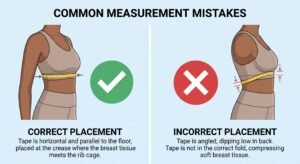
The underbust measurement must be taken at the crease directly below the breasts, where breast tissue meets the rib cage. Positioning the tape even 1 inch (2.5 cm) too low measures the narrower part of the rib cage below the breast root, producing a number that is 1 to 2 inches (2.5 to 5 cm) smaller than the correct underbust. Positioning the tape too high captures breast tissue in the measurement, inflating the number. Use a mirror to verify the tape sits level and directly in the inframammary fold.
Not Keeping the Tape Level
A tape measure that dips lower in the back than in the front, or angles upward on one side, produces an inaccurate reading. The tape must remain parallel to the floor around the entire circumference of your rib cage. Standing in front of a mirror and turning to check the side and back positioning helps ensure the tape stays level. If you find it difficult to keep the tape level while measuring yourself, having someone assist you can improve accuracy.
Pulling Too Tight on the Snug Measurement
The snug underbust measurement should feel firm but not restrictive. A common error is pulling the tape as tight as possible for what should be the snug measurement, which conflates the snug and tight readings. Think of the snug measurement as the pressure a well-fitting band creates when worn on its loosest hook. If the tape leaves a visible indentation in your skin, you are pulling too tight for the snug measurement. Save maximum tension for the tight measurement only.
Holding Your Breath
Inhaling deeply while measuring expands the rib cage by 1 to 3 inches (2.5 to 7.5 cm), producing a loose or snug measurement that does not reflect your normal resting circumference. Breathe naturally during the loose and snug measurements. For the tight measurement, exhale fully and then take the reading while your lungs are empty. This captures the true minimum circumference of your rib cage and provides the most useful data point for band size calculation.
When to Re-Measure Your Underbust
Your underbust measurement can change over time due to weight fluctuation, muscle development, aging, and hormonal shifts. You should re-measure your underbust at least every 6 months to ensure your current bra size still reflects your body’s measurements. Specific situations that warrant immediate re-measurement include weight changes of 10 pounds (4.5 kg) or more, pregnancy and postpartum recovery, starting or changing a fitness routine that targets the core or upper body, and any time your current bras feel noticeably tighter or looser than when you first purchased them.
Bra bands also lose elasticity over time. A band that fit snugly six months ago may now stretch beyond its original tension, making the bra feel loose even though your underbust measurement has not changed. Re-measuring confirms whether the fit issue stems from a change in your body or from wear in the garment itself. If your measurements remain consistent but your bras feel loose, replacing the bra rather than changing your size is typically the right solution.
How Your Underbust Measurement Connects to Your Full Bra Size
The underbust measurement determines one half of your bra size: the band number. The other half, the cup letter, comes from your bust measurement. Cup size is the letter in a bra size (e.g., the C in 34C). It represents the difference between your bust measurement and your underbust measurement. Each letter equals approximately 1 inch (2.54 cm) of difference. A 3-inch (7.6 cm) difference between bust and underbust corresponds to a C cup, while a 5-inch (12.7 cm) difference corresponds to a DD or E cup.
Because the cup letter depends on the relationship between bust and underbust, an inaccurate underbust measurement throws off both the band size and the cup size. Measuring your underbust 2 inches (5 cm) too large, for example, not only produces a band recommendation that is too loose but also reduces the calculated bust-to-underbust difference, resulting in a cup size recommendation that is too small. This double error is one reason inaccurate underbust measurements have such a large impact on overall bra fit.
After measuring your underbust using the three-measurement method described above, the next step is measuring your bust in three positions: standing, leaning forward at 90 degrees, and lying down. Together, these six measurements, three underbust and three bust, provide the data our bra size calculator needs to recommend your most accurate size. For detailed instructions on taking your bust measurements, see the guide on how to measure bra size.
Underbust Measurement FAQ
What is the difference between underbust and bust measurement?
The underbust measurement is the circumference of your rib cage directly below your breasts, while the bust measurement is the circumference around the fullest part of your breasts. The underbust determines your band size (the number), and the difference between bust and underbust determines your cup size (the letter). These two measurements work together to produce your complete bra size.
Can I measure my underbust with a string instead of a tape measure?
Yes. If you do not have a flexible tape measure, wrap a non-stretchy string, ribbon, or cord around your underbust at each tension level (loose, snug, tight). Mark the point where the string meets its starting end, then lay the string flat against a rigid ruler or yardstick to read the measurement in inches or centimeters. This method can introduce small measurement errors if the string stretches or if the marking is imprecise, so a soft tape measure is preferred when available.
Should I round my underbust measurement up or down?
When your snug underbust falls between two even numbers, the calculator considers all three measurements to determine rounding direction. As a general guideline, if your tight underbust is closer to the lower even number, rounding down provides a firmer, more supportive band. If your loose underbust is closer to the upper even number, rounding up may feel more comfortable. Using our bra size calculator eliminates the need to round manually, as the algorithm weighs all three measurements automatically.
Does my underbust measurement change during the day?
Underbust measurements can vary by 0.5 to 1 inch (1 to 2.5 cm) throughout the day due to bloating, water retention, physical activity, and posture changes. For the most consistent results, measure at the same time of day each time you re-measure. Many fitting experts recommend measuring in the morning before eating, as this tends to produce the most stable baseline measurement.
What if my loose and tight underbust measurements are very far apart?
A gap of 4 inches (10 cm) or more between loose and tight underbust measurements is not unusual, particularly for people with more soft tissue around the rib cage. A larger gap typically means you may benefit from a firmer (smaller number) band size to prevent the band from riding up during wear. The calculator accounts for this range automatically, weighting the tight measurement more heavily when the gap is large to ensure adequate support.