
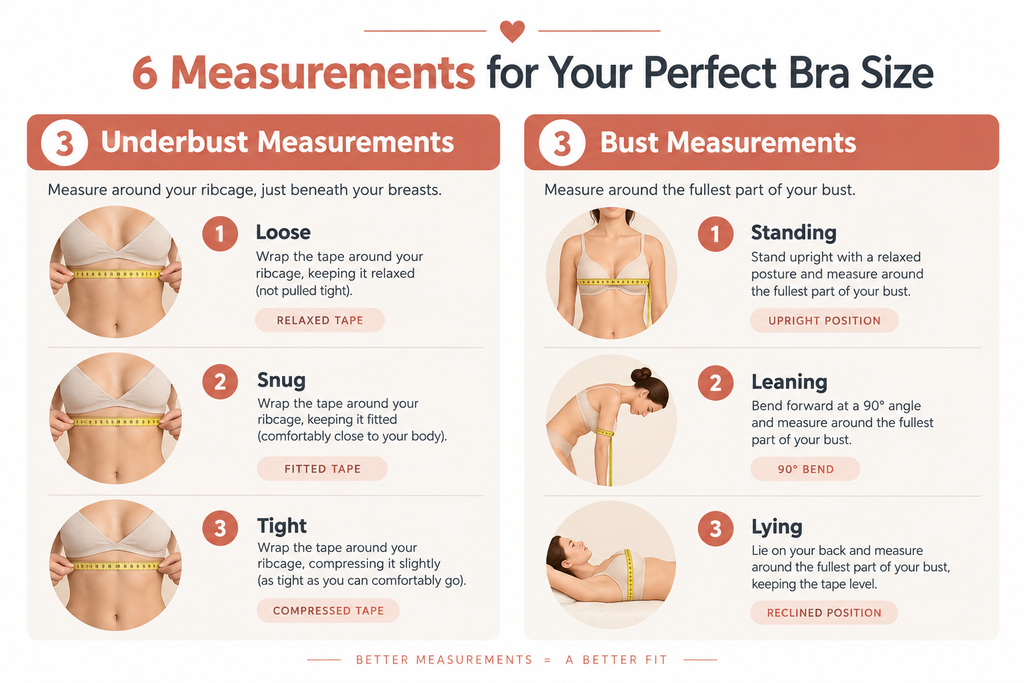
To measure your bra size accurately, you need 6 measurements: 3 underbust (loose, snug, tight) and 3 bust (standing, leaning forward at 90 degrees, lying down). Your underbust determines your band size, and the difference between your bust and band gives you your cup size. This 6-measurement method is more accurate than the traditional 2-measurement approach because it accounts for breast shape, tissue firmness, and projection.
Below is a step-by-step guide covering each measurement, the exact formulas for calculating band and cup size, common mistakes to avoid, and how to measure without a tape measure. Each step includes measurements in both inches and centimeters.
What You Need Before Measuring
3 items are required for an accurate bra size measurement: a soft fabric tape measure, a mirror, and a notepad to record your 6 numbers. A fabric tape measure (also called a sewing tape) is essential because rigid metal tape measures do not conform to your body’s curves and will produce inaccurate readings.
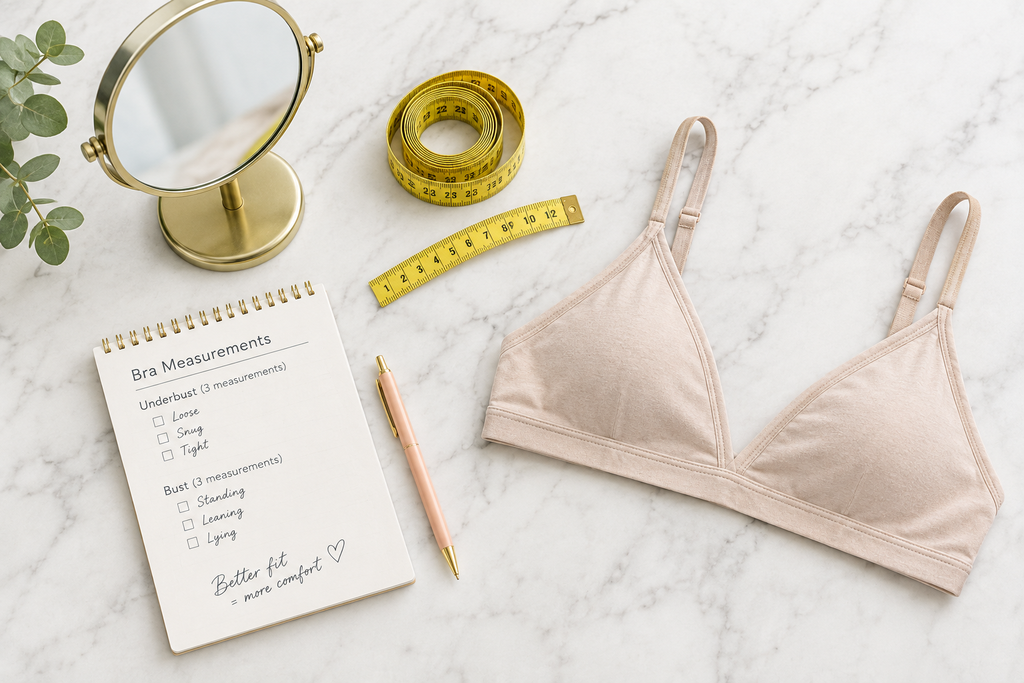
Wear either no bra or a thin, non-padded bra while measuring. Padded bras, push-up bras, and sports bras compress or reshape breast tissue, which adds 0.5 to 2 inches (1.3 to 5.1 cm) of error to your bust measurements. Stand in front of a mirror to confirm the tape is level and parallel to the floor at all times.
Step 1: Measure Your Underbust (3 Measurements)
Your underbust measurement is the foundation of your bra size because it determines your band number. The band provides 80% of a bra’s support, so accuracy here matters more than any other step. You will take 3 separate underbust measurements to capture how your ribcage responds to different levels of compression.
Loose Underbust
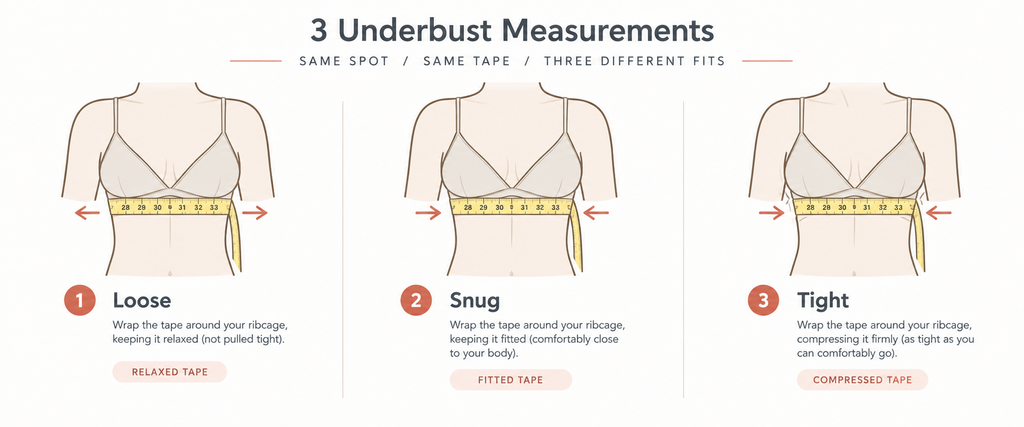
The loose underbust measurement establishes the maximum comfortable band size for your frame. Wrap the tape around your ribcage directly below your breasts, keeping it level and parallel to the floor. Let the tape sit against your skin without pulling or compressing. Exhale normally and read the number. For example, if the tape reads 33 inches (83.8 cm), your loose underbust is 33.
Snug Underbust
The snug underbust measurement is the primary number used to calculate your band size. Place the tape in the same position as the loose measurement. This time, pull the tape firm against your ribcage so it is snug but not uncomfortable. You should be able to slide one finger underneath. Exhale and read the number. A typical snug underbust reads 0.5 to 1.5 inches (1.3 to 3.8 cm) smaller than the loose measurement.
Tight Underbust
The tight underbust measurement reveals the smallest possible band your ribcage can handle. Pull the tape as tight as you physically can around your ribcage, exhale fully, and read the number. This measurement is used to determine how much “squish” your ribcage has, which affects whether you should round your band size up or down. The difference between your loose and tight underbust typically ranges from 1 to 4 inches (2.5 to 10.2 cm).
Recording Your Underbust Numbers
Write down all 3 numbers. For example: Loose 33, Snug 32, Tight 30. These 3 underbust measurements together paint a complete picture of your ribcage that a single measurement cannot capture. The relationship between these numbers determines your ideal band size, which we will calculate in Step 3.
Step 2: Measure Your Bust (3 Positions)
Your bust measurement captures the fullest point of your chest, and taking it in 3 different positions accounts for how breast tissue shifts with gravity. The standing, leaning, and lying measurements each reveal different aspects of your breast volume, shape, and projection. Together, these 3 bust measurements produce a significantly more accurate cup size than a single standing measurement alone.
Standing Bust
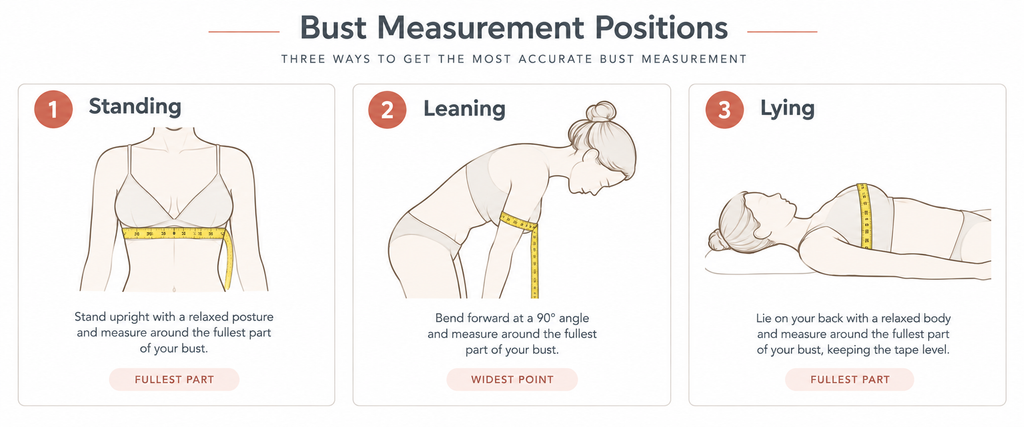
The standing bust measurement captures your breast volume in a natural upright position. Stand straight with your arms relaxed at your sides. Wrap the tape around the fullest part of your bust, keeping it level and parallel to the floor. Do not pull tight or let the tape sag. The tape should rest gently against your skin. For example, if the tape reads 37 inches (94 cm), your standing bust is 37.
Leaning Bust (90 Degrees Forward)
The leaning bust measurement is the most important of the 3 bust measurements because it captures your full breast volume without compression from gravity. Bend forward at the waist to a 90-degree angle so your back is parallel to the floor. Let your breasts hang freely. Wrap the tape around the fullest point, keeping it perpendicular to the floor and parallel to your back. This measurement is typically 0.5 to 3 inches (1.3 to 7.6 cm) larger than your standing bust, depending on breast projection and tissue firmness.
Lying Bust
The lying bust measurement shows how your breast tissue distributes when supported from below. Lie flat on your back and wrap the tape around the fullest part of your bust. This position allows breast tissue to spread toward the sides, so the measurement often falls between the standing and leaning numbers. For those with firm breast tissue, the lying and standing measurements may be nearly identical. For those with softer tissue, the lying bust may read 1 to 2 inches (2.5 to 5.1 cm) different from the standing measurement.
Recording Your Bust Numbers
Write down all 3 bust numbers next to your underbust numbers. A complete set of 6 measurements might look like this: Loose Underbust 33, Snug Underbust 32, Tight Underbust 30, Standing Bust 37, Leaning Bust 38, Lying Bust 37. These 6 numbers are the raw data your band size and cup size calculations require.
Step 3: Calculate Your Band Size
Your band size is calculated from your snug underbust measurement rounded to the nearest even number. If your snug underbust is 32 inches (81.3 cm), your band size is 32. If it is 33 inches (83.8 cm), you round to 34. If it falls exactly on an odd number, the relationship between your 3 underbust measurements determines whether to round up or down.
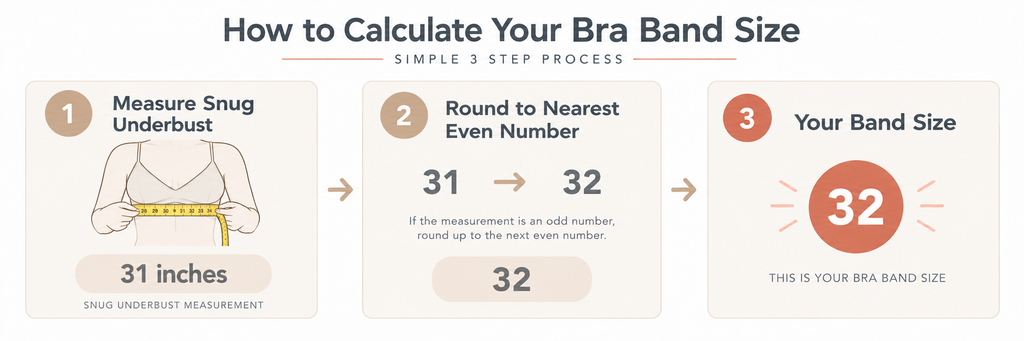
When to round down: if the difference between your loose and tight underbust is 3 inches (7.6 cm) or more, your ribcage has significant compressibility, and rounding down to the smaller even number usually provides better support. When to round up: if the difference between loose and tight is less than 2 inches (5.1 cm), your ribcage is less compressible, and rounding up to the larger even number provides better comfort.
Underbust to Band Size Reference
| Snug Underbust (inches) | Snug Underbust (cm) | US Band Size | EU Band Size |
|---|---|---|---|
| 25-26 | 63.5-66 | 26 | 55 |
| 27-28 | 68.6-71.1 | 28 | 60 |
| 29-30 | 73.7-76.2 | 30 | 65 |
| 31-32 | 78.7-81.3 | 32 | 70 |
| 33-34 | 83.8-86.4 | 34 | 75 |
| 35-36 | 88.9-91.4 | 36 | 80 |
| 37-38 | 94-96.5 | 38 | 85 |
| 39-40 | 99.1-101.6 | 40 | 90 |
| 41-42 | 104.1-106.7 | 42 | 95 |
| 43-44 | 109.2-111.8 | 44 | 100 |
| 45-46 | 114.3-116.8 | 46 | 105 |
| 47-48 | 119.4-121.9 | 48 | 110 |
Note that this table uses standard US sizing. Some brands, most notably Victoria’s Secret, use a “+4 method” that adds 4 inches to the underbust before assigning a band number. Our calculator uses the direct measurement method (no +4) because it produces a more supportive fit for the majority of body types.
Step 4: Calculate Your Cup Size
Cup size equals the difference between your bust measurement and your band size, measured in inches. Each inch of difference corresponds to one cup letter. A 1-inch (2.5 cm) difference is an A cup, a 2-inch (5.1 cm) difference is a B cup, a 3-inch (7.6 cm) difference is a C cup, and so on.
With 3 bust measurements available, your calculator uses all 3 to determine the most accurate cup size. The general approach averages your standing, leaning, and lying bust measurements, though the weighting may vary based on your breast shape and tissue firmness. If your 3 bust numbers are close together (within 1 inch or 2.5 cm of each other), you likely have firm tissue and can use any single measurement. If they vary by 2 inches (5.1 cm) or more, the average provides a more reliable result.
Bust-to-Band Difference and Cup Letter
| Difference (inches) | Difference (cm) | US Cup Size | UK Cup Size |
|---|---|---|---|
| 0 | 0 | AA | AA |
| 1 | 2.5 | A | A |
| 2 | 5.1 | B | B |
| 3 | 7.6 | C | C |
| 4 | 10.2 | D | D |
| 5 | 12.7 | DD/E | DD |
| 6 | 15.2 | DDD/F | E |
| 7 | 17.8 | G | F |
| 8 | 20.3 | H | FF |
| 9 | 22.9 | I | G |
| 10 | 25.4 | J | GG |
| 11 | 27.9 | K | H |
| 12 | 30.5 | L | HH |
Notice that US and UK cup sizes diverge after D cup. US sizing uses DD, DDD, then continues with single letters (G, H, I). UK sizing uses DD, E, F, FF, G, GG, H, HH. Always confirm which sizing system a brand follows before purchasing.
Worked Example
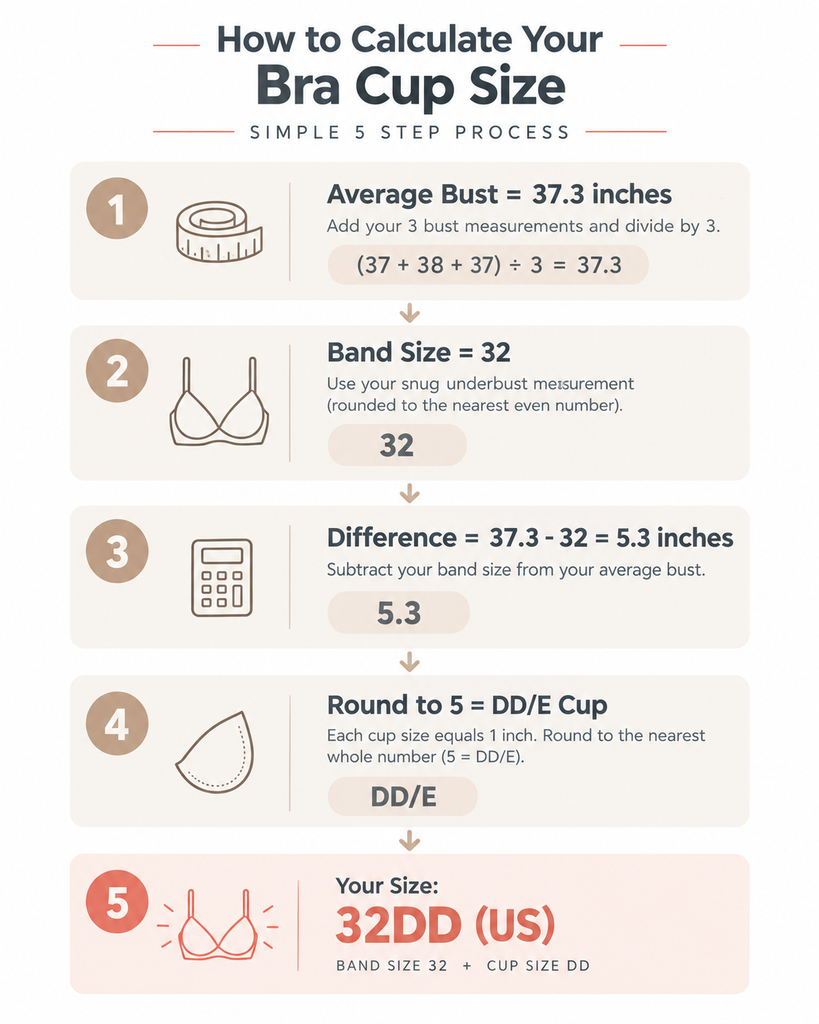
Using the example measurements from earlier: Snug Underbust 32, Standing Bust 37, Leaning Bust 38, Lying Bust 37. Band size is 32 (snug underbust rounded to nearest even). Average bust is (37 + 38 + 37) / 3 = 37.3 inches (94.7 cm). Difference: 37.3 minus 32 = 5.3. Rounding to the nearest whole number gives 5 inches, which corresponds to a DD/E cup. Your calculated size is 32DD (US) or 32DD (UK).
Step 5: Find Your Sister Sizes
Sister sizes are bra sizes with the same cup volume but different band and cup combinations. Knowing your sister sizes gives you more options when your exact size is unavailable or when a particular brand runs tight or loose in the band.
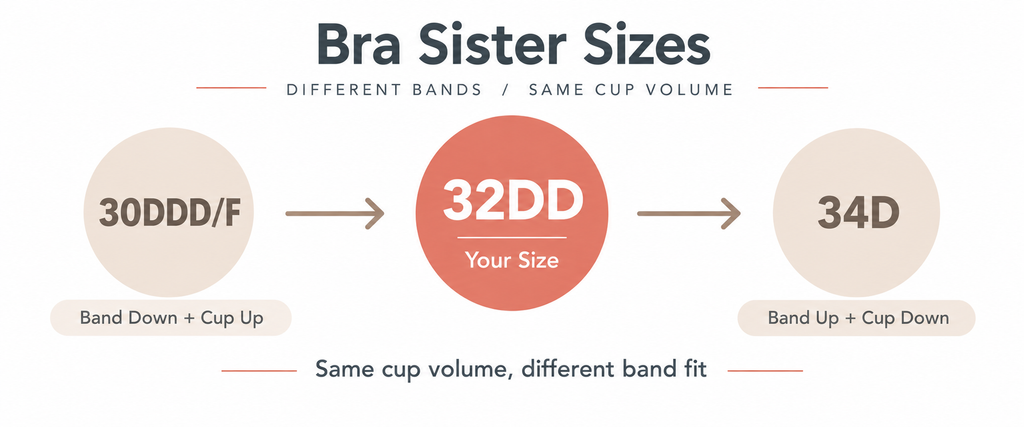
To find your sister sizes, move one band size down and one cup size up (for a tighter band with the same volume), or one band size up and one cup size down (for a looser band with the same volume). For the 32DD example above, the sister sizes are 30E/DDD (band down, cup up) and 34D (band up, cup down). All three sizes contain approximately the same cup volume of 400cc.
Use our sister size calculator to find all equivalent sizes for your measurement, including international conversions.
How to Measure Bra Size Without a Tape Measure
2 alternative methods work when you do not have a soft tape measure available: the string method and the ruler method. Both produce measurements accurate to within 0.5 inches (1.3 cm) when done carefully.
String Method
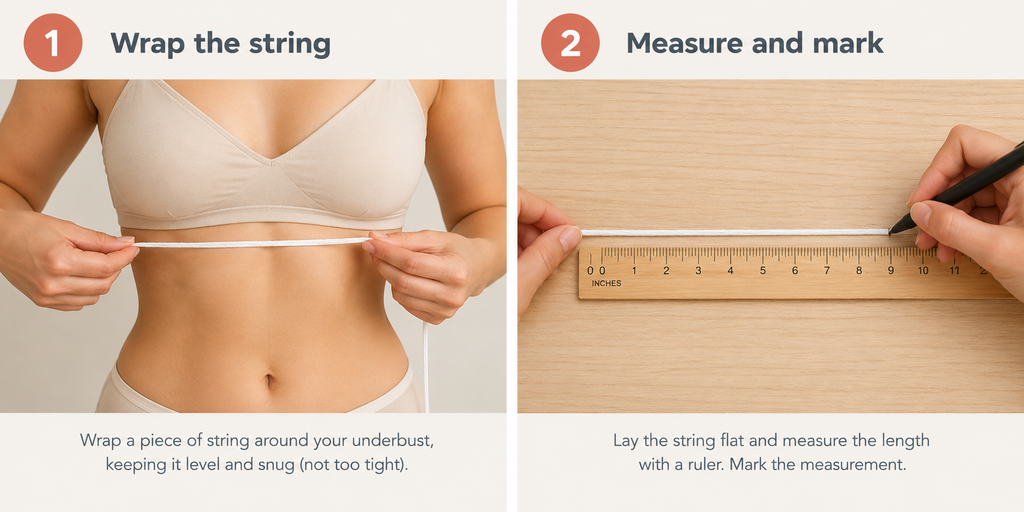
Use a non-stretchy string, ribbon, or shoelace. Wrap it around your body in the same positions described above (underbust and bust). Mark where the string meets its starting point with a pen or pinch it between your fingers. Lay the marked string flat against a rigid ruler or yardstick and read the measurement. Repeat for all 6 measurements. Avoid elastic strings, yarn, or stretchy cord because they elongate under tension and produce readings that are 0.5 to 1 inch (1.3 to 2.5 cm) too small.
Ruler Method
If you only have a rigid ruler shorter than your circumference, measure in segments. Hold the ruler against your body, mark the endpoint on your skin with a washable marker, then continue measuring from that mark. Add all segments together for the total circumference. This method is slower but works in situations where no flexible measuring tool is available.
Common Bra Measurement Mistakes
5 measurement errors account for the majority of incorrect bra size calculations. Avoiding these mistakes can shift your result by 1 to 3 cup sizes, which is the difference between a bra that fits and one that gaps, digs, or rides up.
Measuring Over a Padded Bra
Padded and push-up bras add 0.5 to 2 inches (1.3 to 5.1 cm) to your bust measurement, inflating your calculated cup size. Always measure with no bra or a thin, non-padded bralette. If you must wear a bra, choose one with no padding, no underwire, and minimal structure.
Pulling the Tape Too Tight or Too Loose
A tape pulled too tight compresses breast tissue and underestimates bust size. A tape left too loose adds extra circumference. The correct tension for the snug underbust is firm enough that you can slide one finger underneath. For bust measurements, the tape should touch your skin without indenting it.
Not Keeping the Tape Level
A tape that tilts higher in the back than the front (or vice versa) produces inconsistent readings. Check in a mirror to confirm the tape runs level and parallel to the floor at every measurement point. On the bust measurement, the tape should cross the fullest point of both breasts at the same height.
Taking Only One Bust Measurement
The traditional method of measuring only the standing bust misses breast tissue that projects forward (captured by the leaning measurement) and tissue that spreads laterally (captured by the lying measurement). This single-measurement approach commonly underestimates cup size by 1 to 2 cups for those with projected or soft breast tissue.
Using the +4 Band Method
Some older fitting guides instruct you to add 4 inches to your underbust measurement before determining band size. This method, still used by certain retailers, typically results in a band that is too loose and a cup that is too small. The direct measurement method (no +4) produces a band that sits firmly against your ribcage and provides proper support. Our bra size calculator uses the direct method.
When to Re-Measure Your Bra Size
Bra size is not a fixed number. Your measurements can change due to weight fluctuations, hormonal cycles, pregnancy, nursing, aging, and changes in muscle mass. Fitting experts recommend re-measuring at least every 6 months, and immediately after any significant body change.
Weight Changes
A weight change of 10 pounds (4.5 kg) or more commonly shifts bra size by at least one cup size, and sometimes one band size as well. Weight gain typically increases bust size first, while weight loss often reduces band size before cup size.
Pregnancy and Nursing
Breast volume can increase by 1 to 3 cup sizes during pregnancy and may fluctuate further during nursing. Measuring at regular intervals throughout pregnancy (every trimester) and during nursing (every 2 to 3 months) helps maintain a proper fit as your body changes.
Aging and Hormonal Changes
Hormonal shifts during perimenopause and menopause can change breast density and volume. Band size may also change as ribcage shape shifts with age. Annual measurements after age 40 help track these gradual changes.
Exercise and Muscle Changes
Building chest or back muscle through strength training can increase your underbust measurement by 0.5 to 2 inches (1.3 to 5.1 cm), changing your band size. Significant weight training may require re-measuring every 3 to 4 months.
Frequently Asked Questions About Bra Measurement
How do I know if my bra fits correctly?
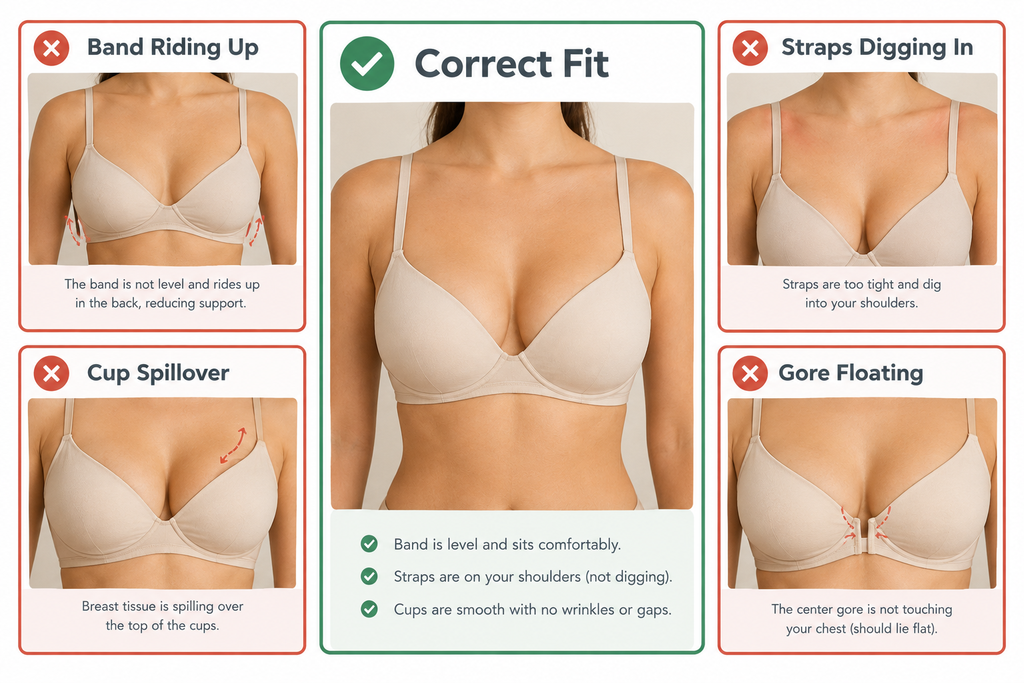
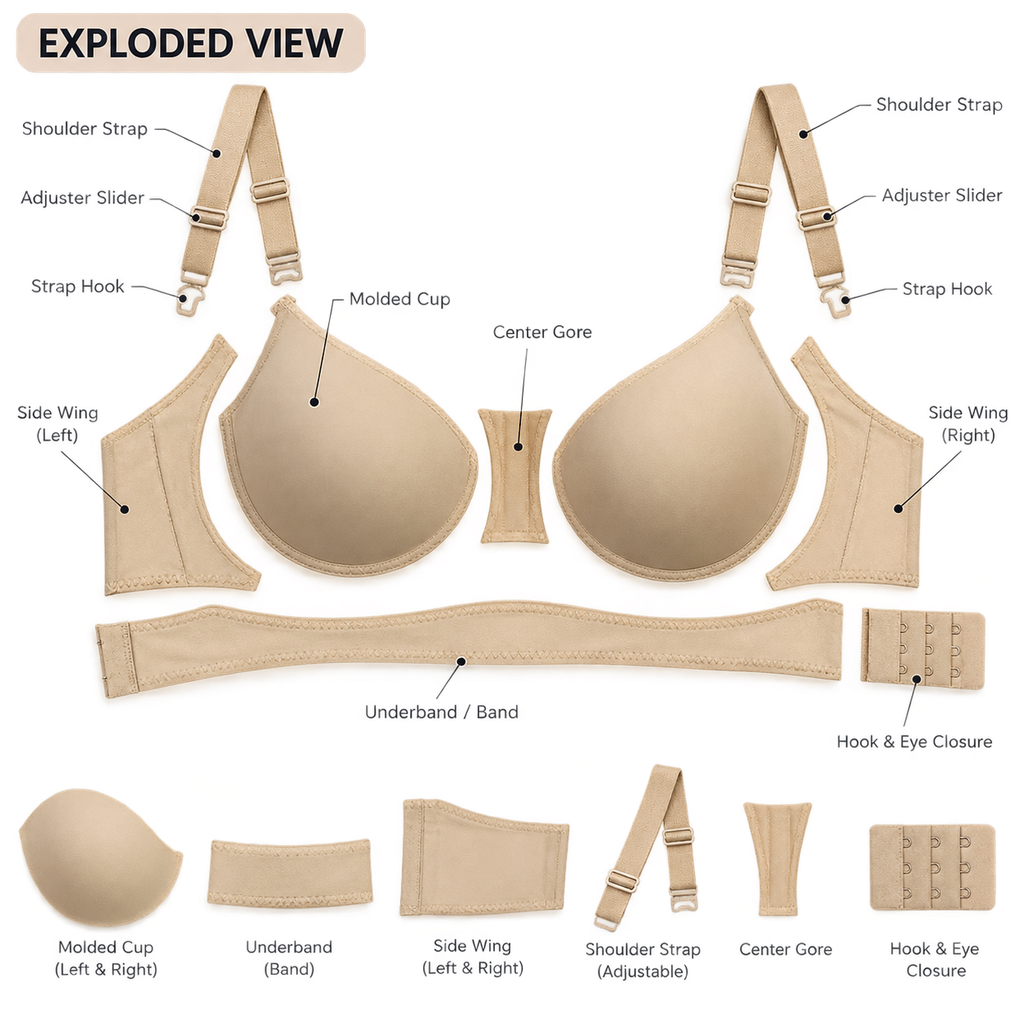
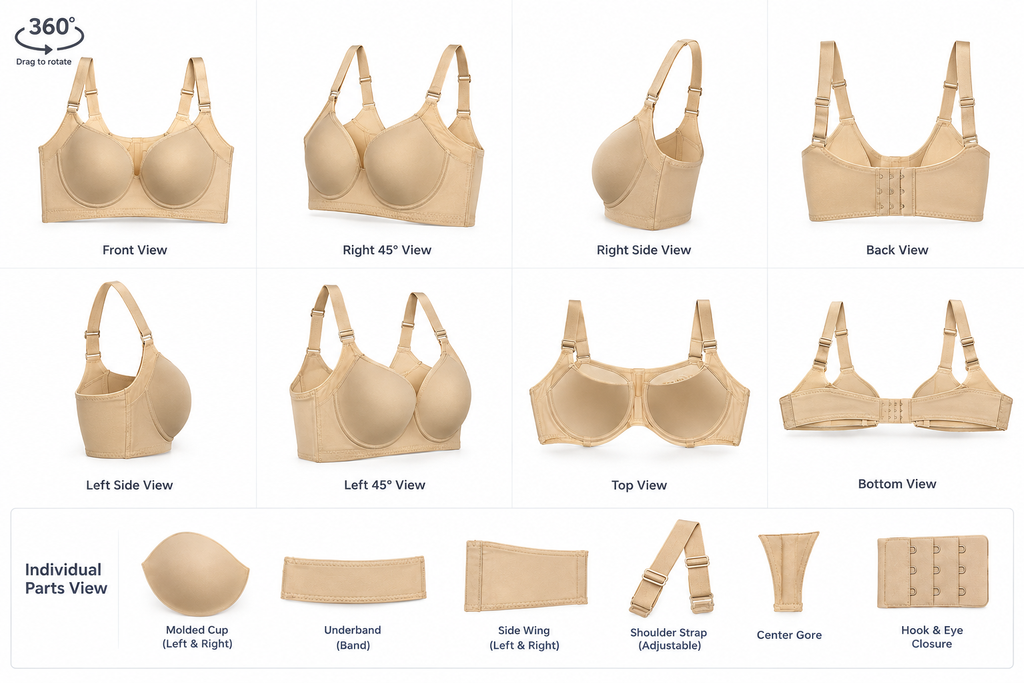
A correctly fitting bra has a band that sits level around your torso without riding up in the back, cups that fully contain your breast tissue without gapping or spilling, and straps that stay in place without digging into your shoulders. The center gore (the piece between the cups) should lie flat against your sternum. If any of these elements are off, re-measure using the 6-measurement method above and recalculate your size.
Why is my measured size different from what I normally wear?
Approximately 80% of women wear a bra size that does not match their actual measurements, according to fitting professionals. The most common pattern is wearing a band too large and a cup too small. If your measured size feels surprising, try it on before dismissing the result. Many people find that their measured size fits significantly better than their “usual” size.
Do all brands use the same sizing?
No. Bra sizing is not standardized across brands. A 34C from one brand may fit differently than a 34C from another. Some brands like Victoria’s Secret use the +4 method, while others use direct measurement. European brands use a completely different numbering system (EU 75C = US 34C). Always check a brand’s specific size chart and compare it to your actual measurements in inches or centimeters rather than relying on the size label alone.
Can I measure myself, or do I need someone to help?
You can measure yourself accurately using a mirror. Stand in front of a mirror, wrap the tape, and check that it is level before reading the number. The mirror replaces the need for a second person. If the tape keeps slipping during the leaning bust measurement, use a small piece of tape to hold one end in place while you read the number.
How accurate is this method compared to a professional fitting?
The 6-measurement method used here captures more data points than most in-store fittings, which typically use only 2 measurements (one underbust, one standing bust). Professional fitters compensate for this with experience and visual assessment, but a careful self-measurement using 6 data points produces results that match professional fittings within one cup size in over 90% of cases.
Calculate Your Bra Size Now
Enter your 6 measurements into our bra size calculator to get your exact bra size in US, UK, EU, and Australian sizing. The calculator also provides your sister sizes, recommendations for your breast shape, and links to our complete size chart with measurements for every size from 28AA to 48N.