What Is Bra Band Size?
Bra band size is the number in your bra size (the 34 in 34C, for example) and it corresponds to your underbust measurement in inches, rounded to the nearest even number. The band is the horizontal strip of fabric that wraps around your rib cage, and it provides approximately 80% of a bra’s support. Getting your band size right is the single most important step in finding a bra that fits correctly.
Your band size is determined by measuring the circumference of your rib cage directly below your breasts. This underbust measurement, taken in inches, maps to a specific even number: a rib cage measuring 33 inches typically corresponds to a 34 band, while a 31-inch measurement points to a 32 band. Accurate results from our bra size calculator depend on understanding how your underbust measurement translates to a band number.
Band sizes in US sizing range from 26 to 52, with the most common sizes falling between 32 and 38. Each band size covers a measurement range of approximately 2 inches, and the number itself represents the stretched length of the band rather than your exact rib cage circumference. This distinction matters because bra bands are designed with elastic stretch that provides a snug, supportive fit.
How Band Size Is Calculated from Your Measurements
Band size calculation starts with three underbust measurements: loose, snug, and tight. These three readings capture different levels of compression against your rib cage and account for the varying stretch found across different bra brands and styles.
The loose underbust is taken with the tape measure resting on the skin without tension. The snug underbust uses firm, comfortable pressure. The tight underbust pulls the tape as tight as physically comfortable while exhaling fully. Together, these three measurements create a range that determines which band size will provide the best fit.
Here is how each underbust measurement range maps to a specific band size number:
| Underbust Range (inches) | Underbust Range (cm) | Band Size |
|---|---|---|
| 24.5 to 25.5 | 62 to 65 | 26 |
| 25.5 to 27.5 | 65 to 70 | 28 |
| 27.5 to 29.5 | 70 to 75 | 30 |
| 29.5 to 31.5 | 75 to 80 | 32 |
| 31.5 to 33.5 | 80 to 85 | 34 |
| 33.5 to 35.5 | 85 to 90 | 36 |
| 35.5 to 37.5 | 90 to 95 | 38 |
| 37.5 to 39.5 | 95 to 100 | 40 |
| 39.5 to 41.5 | 100 to 105 | 42 |
| 41.5 to 43.5 | 105 to 110 | 44 |
| 43.5 to 45.5 | 110 to 116 | 46 |
| 45.5 to 47.5 | 116 to 121 | 48 |
| 47.5 to 49.5 | 121 to 126 | 50 |
| 49.5 to 51.5 | 126 to 131 | 52 |
When your snug underbust measurement falls between two band sizes, the tight measurement helps determine which direction to round. A tighter measurement closer to the lower band suggests sizing down, while a looser overall range suggests sizing up. Our bra size calculator uses all three underbust measurements to determine the most accurate band size for your body.
Why Band Size Matters More Than You Think
The band delivers roughly 80% of a bra’s support, making it the structural foundation of every bra. A band that fits correctly sits level around the body, parallel to the floor, and stays firmly in place without riding up the back. When the band is too loose, the straps carry weight they were never designed to bear, which leads to shoulder pain, strap digging, and inadequate support.
Band size also directly determines cup size, because cup letters are relative to the band. The letter in a bra size (the C in 34C) represents the difference between your bust measurement and your underbust measurement, with each letter equaling approximately 1 inch (2.54 cm) of difference. This means a C cup on a 32 band holds a different volume than a C cup on a 38 band. A 32C has a bust measurement of approximately 35 inches, while a 38C has a bust measurement of approximately 41 inches. The cup letter is the same, but the actual breast volume differs significantly.
Approximately 80% of women wear the wrong bra size, according to multiple professional fitting studies, and the most common error is wearing a band that is too large. Many traditional sizing methods, including the outdated +4 method, systematically overestimate band size by instructing women to add 4 inches to their underbust measurement. This results in a loose band that rides up and a cup that appears too small, leading women to size down in the cup when the real problem is the band.
How to Find Your Band Size at Home
Finding your correct band size requires a soft measuring tape and a mirror. The process takes less than 5 minutes and should be done while wearing a non-padded bra or no bra at all.
Step 1: Measure your loose underbust. Stand in front of a mirror and wrap the tape measure around your rib cage, directly below your breasts. Keep the tape level and parallel to the floor. Let it rest on your skin without pulling or compressing. Record this number in inches.
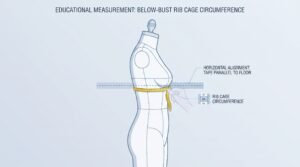
Step 2: Measure your snug underbust. In the same position, wrap the tape around your underbust again. This time, pull it firm enough that it stays in place without sliding, but not so tight that it digs into your skin. This represents the feel of a well-fitting bra band. Record this number.
Step 3: Measure your tight underbust. Wrap the tape one more time, exhale fully, and pull as tight as you physically can while still being comfortable. This measurement establishes the lower boundary of your band range and helps determine whether your rib cage has enough compressibility for a snugger band. Record this number.
Step 4: Find your band number. Your snug underbust measurement is the primary indicator. Round it to the nearest even number. If your snug underbust measures 33 inches, your starting band size is 34. If it measures 30 inches, your band size is 30. Use the conversion table above to confirm, and verify your result with our bra size calculator for the most precise recommendation based on all three measurements.
For a complete walkthrough of all six measurements (three underbust plus three bust positions), see our how to measure bra size guide.
Band Size and Sister Sizes
Sister sizes are bra sizes with the same cup volume but different band and cup combinations. Going up a band size means going down a cup letter, and vice versa. This relationship is built directly on band size mechanics: when the band gets larger, the same cup volume requires a smaller cup letter because the larger band already covers more chest area.
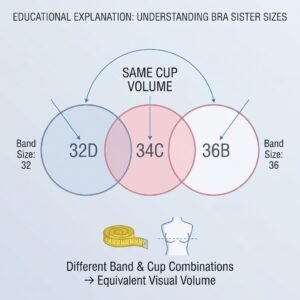
For example, a 34C has the following sister sizes:
| Direction | Sister Size | Band Change | Cup Change | Cup Volume |
|---|---|---|---|---|
| One band down | 32D | 34 to 32 | C to D | ~310cc (same) |
| Original size | 34C | 34 | C | ~310cc |
| One band up | 36B | 34 to 36 | C to B | ~310cc (same) |
Sister sizes become relevant when your band size falls between two numbers or when a specific brand runs tight or loose in the band. If a 34 band feels slightly snug, trying a 36B (one band up, one cup down) maintains the same cup volume with a more relaxed band. Conversely, if a 34 band rides up, a 32D provides a firmer fit with the same breast coverage.
Understanding this relationship between band sizing and cup sizing prevents a common mistake: changing only the cup letter when the real issue is the band. For more on how sister sizes work across every bra size, visit our sister size chart.
Band Size in International Sizing Systems
Band size notation varies significantly across international bra sizing systems. The US system uses inches (32, 34, 36), while the European (EU) system uses centimeters (70, 75, 80). The UK system mirrors US band numbers but diverges in cup letter progression. Australian (AU) sizing uses a completely different numbering scale.
Here is how common US band sizes convert across international systems:
| US Band | UK Band | EU Band | AU Band | FR/ES Band | Underbust (inches) | Underbust (cm) |
|---|---|---|---|---|---|---|
| 28 | 28 | 60 | 6 | 75 | 26 to 27 | 63 to 67 |
| 30 | 30 | 65 | 8 | 80 | 28 to 29 | 68 to 72 |
| 32 | 32 | 70 | 10 | 85 | 30 to 31 | 73 to 77 |
| 34 | 34 | 75 | 12 | 90 | 32 to 33 | 78 to 82 |
| 36 | 36 | 80 | 14 | 95 | 34 to 35 | 83 to 87 |
| 38 | 38 | 85 | 16 | 100 | 36 to 37 | 88 to 92 |
| 40 | 40 | 90 | 18 | 105 | 38 to 39 | 93 to 97 |
| 42 | 42 | 95 | 20 | 110 | 40 to 41 | 98 to 102 |
| 44 | 44 | 100 | 22 | 115 | 42 to 43 | 103 to 107 |
The EU system measures the underbust in centimeters and rounds to the nearest 5 (so a 75 cm underbust becomes EU 75, which corresponds to a US 34). The French and Spanish systems add 15 cm to the EU number, making FR 90 equivalent to EU 75 and US 34. The Australian system uses an entirely separate scale that counts up from 6 (AU 6 = US 28) in increments of 2.
When shopping internationally, always convert your measured band size rather than assuming the numbers match. A full conversion chart with every band and cup combination is available on our international bra size conversion page.
Common Band Size Mistakes
The most frequent band size error is using the +4 method, an outdated sizing technique that adds 4 inches to your underbust measurement. This method was developed decades ago when bra bands contained minimal elastic and needed extra length to fasten comfortably. Modern bra bands are engineered with stretch fabric that conforms to the body, making the +4 addition unnecessary and inaccurate. A woman with a 30-inch underbust would be placed in a 34 band using the +4 method, despite a 30 or 32 band being her correct fit.
Another common mistake is measuring over a padded bra. Padding adds volume that inflates the underbust reading, pushing the band size higher than it should be. Always measure against bare skin or over a thin, non-padded bra for the most accurate reading.
Measuring while inhaling deeply also distorts results. The rib cage expands during inhalation, artificially increasing the circumference. Take your snug and tight measurements during a normal exhale for consistent, repeatable readings.
Finally, many people assume their band size stays constant. Body weight changes, aging, pregnancy, and hormonal fluctuations can all shift your underbust measurement. Fitting experts recommend re-measuring at least every 6 months to confirm your current band size still matches your bra collection.
Signs Your Band Size Is Wrong
A band that is too large produces a distinct set of fit symptoms. The most obvious sign is the band riding up in the back. When you raise your arms, the band should stay level or move only slightly. If it slides up toward your shoulder blades, the band is not snug enough to anchor against your rib cage. Other signs of a too-large band include straps that constantly fall off the shoulders (the straps compensate for a loose band by pulling upward) and a center gore (the piece between the cups) that floats away from the sternum instead of sitting flat.
A band that is too small creates the opposite problems. Red marks or indentations around the rib cage after removing the bra indicate excessive compression. Difficulty breathing, the band feeling like it constricts the rib cage, and the fabric digging into the sides all suggest the band number needs to increase. A too-tight band also pushes breast tissue out from under the cups, creating the appearance of spillage that might be mistaken for a cup size problem.
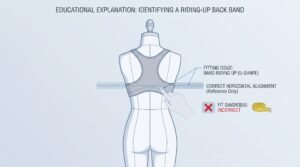
The hook test offers a quick diagnostic. A new bra should fasten comfortably on the loosest (outermost) hook. As the band stretches with wear over the following months, you move inward to the tighter hooks. If you need the tightest hook from day one, the band is already too large. If the loosest hook feels restrictive, the band may be too small.
For a complete fit assessment covering all five checkpoints (band, cups, gore, straps, and underwire), see our bra fit guide.
Band Size by Bra Type
Different bra types interact with band size in different ways, and understanding these variations helps you choose the right band for each style.
Underwire bras rely heavily on a precise band fit because the underwire must sit in the inframammary fold (the crease where the breast meets the rib cage). A band that is too large allows the underwire to slide down, while a band that is too small forces the wire onto breast tissue instead of resting on the rib cage.
Sports bras often use a compression design that substitutes S/M/L sizing for the traditional band-plus-cup system. When converting, your measured band size maps to a letter range: 30 to 32 typically corresponds to S, 34 to 36 maps to M, and 38 to 40 maps to L. However, encapsulation-style sports bras use standard band-plus-cup sizing and should be fitted with the same underbust measurement approach.
Bralettes generally use S/M/L sizing without underwire, so the band provides less structured support. Many women can wear a broader band range in bralettes than in underwire styles. A bralette band should feel snug but not constraining, similar to a well-fitting tank top.
Strapless bras depend entirely on the band for support since there are no straps to assist. For strapless styles, some fitting experts suggest trying one band size smaller than your standard size to compensate for the absence of strap support. A strapless 32D may feel similar in support to a standard 34C with straps.
For detailed sizing guidance on each bra type, explore our sports bra size guide and other bra type pages.
Frequently Asked Questions About Band Size
What does the number in a bra size mean?
The number in a bra size is the band size. It corresponds to your underbust measurement in inches, rounded to the nearest even number. The band wraps around your rib cage and provides the primary support structure. A 34C bra has a 34-inch band, meaning it is designed for an underbust measurement of approximately 33 to 34 inches (84 to 86 cm).
Is band size the same as chest size?
Band size and chest size are related but not identical. Band size corresponds to the underbust measurement (below the breasts), while “chest size” can refer to different measurements depending on context. In men’s clothing, chest size measures around the fullest part of the chest. In bra sizing, the equivalent of this fuller measurement is the bust measurement, which determines the cup letter, not the band number.
Can I wear the same band size in every brand?
Band sizes can vary by 1 to 2 inches across different brands due to differences in elastic stretch, fabric composition, and sizing standards. A 34 band in one brand may feel like a 32 in another. Always verify your fit with each new brand. If a brand runs tight in the band, consider trying your sister size one band up. If a brand runs loose, try one band down. Our brand-specific size guides detail how popular brands compare to standard sizing.
Does band size change with weight gain or loss?
Yes. The rib cage area can gain or lose fat tissue with weight fluctuation. A weight change of 10 to 15 pounds may shift your underbust measurement by 1 to 2 inches, potentially moving your band size up or down by one number. Hormonal changes, pregnancy, and aging also affect rib cage circumference. Re-measuring your underbust every 6 months ensures your band size stays current.
Why do bra bands have multiple hook positions?
Multiple hook positions (typically 2 to 4 columns) accommodate the natural stretching of elastic over time. A new bra should fasten on the loosest hook to allow room for the band to stretch. As the elastic relaxes through wear and washing, you move to progressively tighter hooks to maintain the same level of support. When the tightest hook no longer provides a snug fit, the bra band has reached the end of its functional life.
What band size is considered plus size?
In the US market, band sizes 38 and above are generally categorized as plus size or extended size. However, this classification varies by brand. Some brands begin their plus-size range at 40, while others consider 36 and above to be extended. Band sizes 44 through 52 are available from specialist retailers including Lane Bryant (Cacique), Elomi, and Goddess. The measurement method remains exactly the same regardless of band size: measure your underbust, round to the nearest even number, and verify with the bra size calculator.
Understanding your band size is the foundation of finding a bra that fits. The band carries the majority of the support load, determines your cup size relationship, and connects to sister sizes across the sizing spectrum. Start with accurate underbust measurements, use the conversion table above, and confirm your result with our bra size calculator for a complete size recommendation including cup size and bra size chart reference.